Twelfth Night
Dive into Shakespeare's brilliantly chaotic comedy of mistaken identity, unrequited love, and festive misrule. 'Twelfth Night' offers rich opportunities for high-level analysis of gender, social ambition, and the illusion of romance.
Study Notes
Overview
'Twelfth Night' is one of Shakespeare's most celebrated festive comedies, blending a poignant exploration of love and loss with the riotous comedy of the Malvolio subplot. Set in the dreamlike world of Illyria, the play uses the trope of twins separated by a shipwreck to examine the fluidity of gender, the performative nature of desire, and the disruption of social order. For examiners, top-tier responses (Level 5/6) will move beyond recounting the plot to analyze Shakespeare's structural intertwining of the main plot and subplot, his use of disguise as a dramatic device, and his critique of both self-indulgent romance (Orsino) and Puritanical ambition (Malvolio). Understanding the Elizabethan context of boy actors and the Twelfth Night festival of misrule is essential for achieving high AO3 marks.
Listen to our revision podcast for a deep dive into the text:
Plot/Content Overview
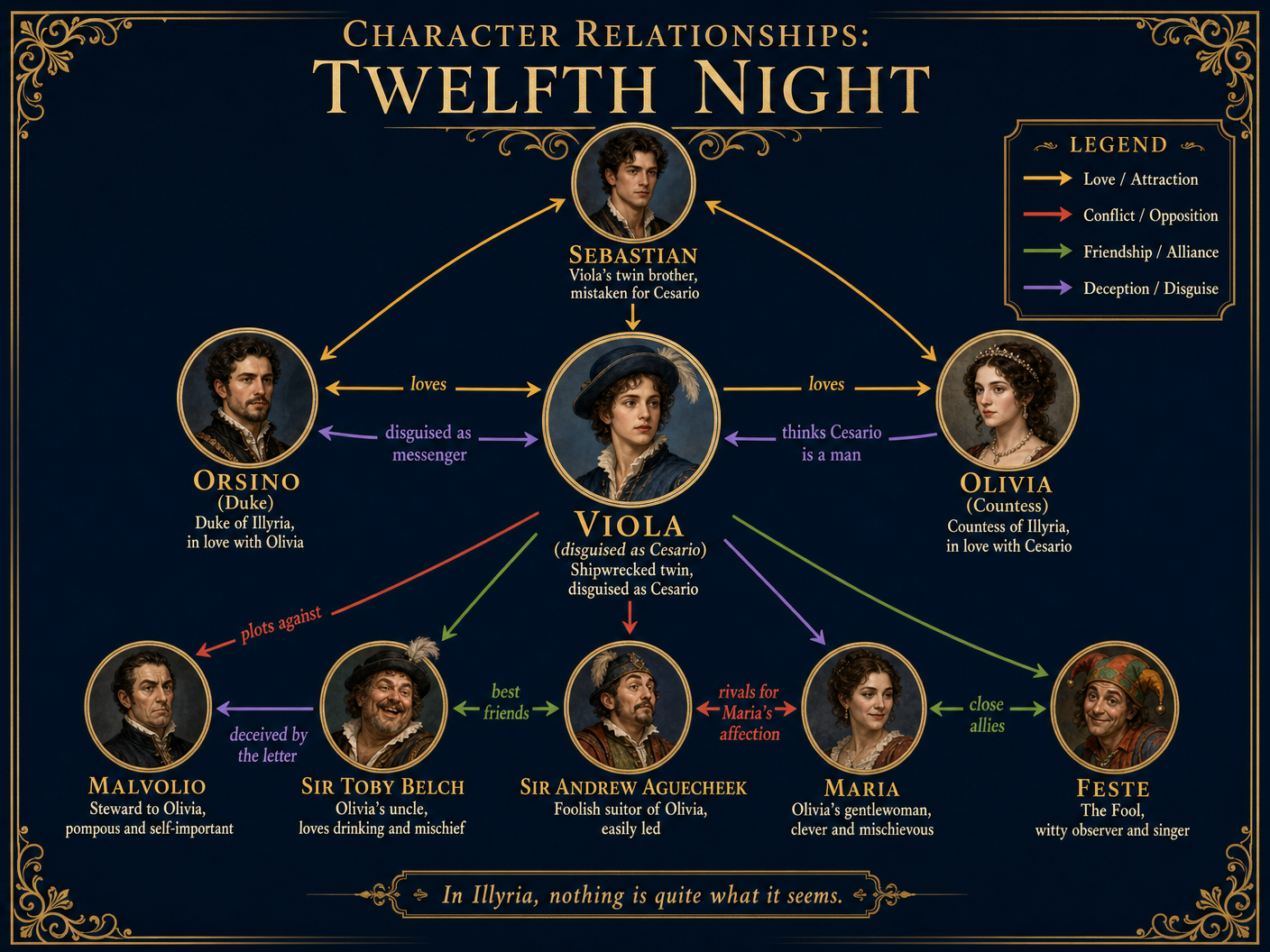
Act 1: Duke Orsino pines for the mourning Countess Olivia. Viola survives a shipwreck, believing her twin Sebastian is dead, and disguises herself as a young man named Cesario to serve Orsino. Orsino sends Cesario to woo Olivia, but Olivia falls in love with Cesario instead.
Act 2: Sebastian is revealed to be alive, rescued by Antonio. In Olivia's household, the drunken Sir Toby Belch, Sir Andrew Aguecheek, and Maria plot against the pompous steward Malvolio, dropping a forged letter to make him believe Olivia loves him. Viola realizes the love triangle she is trapped in.
Act 3: Malvolio appears before Olivia cross-gartered and smiling, leading her to think him mad. Sir Toby orchestrates a duel between Sir Andrew and Cesario. Antonio intervenes, mistaking Cesario for Sebastian, and is arrested, feeling betrayed when 'Sebastian' doesn't know him.
Act 4: Sebastian arrives in Illyria. Feste the Fool and Sir Andrew mistake him for Cesario. Olivia also mistakes Sebastian for Cesario and hastily marries him.
Act 5: All characters converge. The twins are reunited, untangling the mistaken identities. Orsino realizes he loves Viola. Malvolio is released from the dark room, vowing revenge on everyone, casting a shadow over the festive, marital resolution.
Themes
Theme 1: Love and Desire
Shakespeare presents love not as a single emotion, but as a complex, often irrational force. Orsino's love is performative and self-indulgent; he is in love with the idea of being in love. Viola's love is patient and genuine, while Olivia's is sudden and overwhelming. The play asks the audience to evaluate the authenticity of these different experiences of desire.
Key Quotes:
- "If music be the food of love, play on" (Act 1, Scene 1) - Orsino's opening line establishes his excessive, consuming appetite for romance.
- "Make me a willow cabin at your gate, / And call upon my soul within the house" (Act 1, Scene 5) - Viola (as Cesario) demonstrates passionate, devoted love, contrasting with Orsino's passivity.
Theme 2: Identity and Disguise
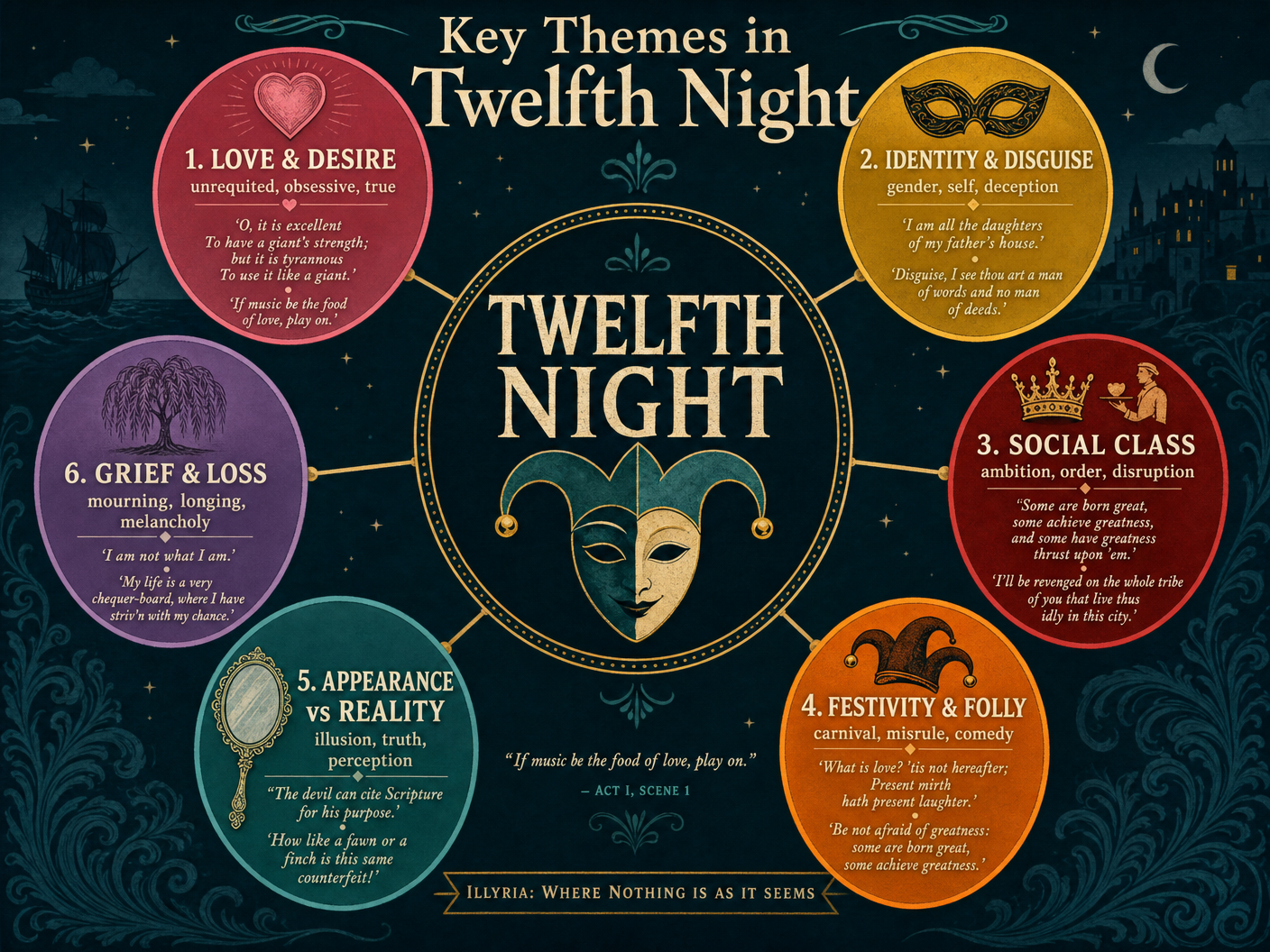
Disguise is the central engine of the plot. Viola's physical disguise as Cesario allows Shakespeare to explore the fluidity of gender and the gap between appearance and reality. The theme extends beyond physical disguise: Orsino disguises his lust as noble love, and Malvolio attempts to disguise his class status.
Key Quotes:
- "I am all the daughters of my father's house, / And all the brothers too" (Act 2, Scene 4) - Viola's layered irony highlights the complexity of her dual identity.
- "Disguise, I see thou art a wickedness" (Act 2, Scene 2) - Viola recognizes the destructive potential of her deception.
Theme 3: Social Class and Ambition
The Malvolio subplot serves as a sharp critique of social climbing and Puritanism. Malvolio's desire for Olivia is driven less by romance than by a thirst for power and status. His humiliation reflects the Elizabethan anxiety about the disruption of the rigid social hierarchy.
Key Quotes:
- "Some are born great, some achieve greatness, and some have greatness thrust upon 'em" (Act 2, Scene 5) - The forged letter feeds Malvolio's fatal flaw: his unchecked ambition.
- "I'll be revenged on the whole pack of you" (Act 5, Scene 1) - Malvolio's final line disrupts the comedic resolution, showing the dark consequences of social transgression.
Character Analysis
Viola / Cesario
Role: The protagonist and catalyst for the plot's confusion and resolution.
Key Traits: Resourceful, articulate, patient, empathetic.
Character Arc: Moves from a state of grief and isolation to finding true love, maintaining her moral compass while navigating a web of deception.
Essential Quotes:
- "I am not what I am."
- "My state is desperate for my master's love."
Duke Orsino
Role: The ruler of Illyria, representing the excesses of courtly love.
Key Traits: Melancholic, self-indulgent, changeable, poetic.
Character Arc: Transitions from a performative obsession with Olivia to a genuine connection with Viola, though his sudden shift highlights his fickle nature.
Essential Quotes:
- "O, it is excellent / To have a giant's strength; but it is tyrannous / To use it like a giant."
- "For such as I am all true lovers are."
Malvolio
Role: Olivia's steward, the antagonist of the subplot and embodiment of Puritan killjoy.
Key Traits: Pompous, ambitious, humorless, gullible.
Character Arc: Rises in his own mind to the status of a lord, only to be brutally cast down and humiliated, ending in unresolved bitterness.
Essential Quotes:
- "Dost thou think, because thou art virtuous, there shall be no more cakes and ale?" (Spoken to him by Sir Toby)
- "To be Count Malvolio!"
Writer's Methods
Shakespeare employs a range of dramatic and linguistic methods to shape meaning. Dramatic irony is pervasive, as the audience knows Viola's true identity while the other characters do not, creating both comedy and tension. He uses prose for the lower-class characters and comedic scenes (Sir Toby, Maria), and blank verse (iambic pentameter) for noble characters and elevated emotions (Orsino, Viola). The structure masterfully parallels the main plot and subplot, using Malvolio's literal imprisonment in the dark room to mirror the metaphorical 'madness' of love experienced by Orsino and Olivia.
Context
Examiners expect candidates to integrate context seamlessly. The play's title refers to the Feast of Epiphany (Twelfth Night), a Tudor festival characterized by 'misrule', where social roles were reversed, servants mocked masters, and normal order was suspended. This directly informs the chaotic events in Illyria. Furthermore, the Elizabethan stage utilized boy actors for female roles. Thus, a boy played Viola, who disguises herself as a boy (Cesario), adding a meta-theatrical layer to the play's exploration of gender fluidity and the performative nature of identity. Finally, Malvolio represents the rising Puritan movement in England, which opposed the theatre and festive traditions; his punishment reflects the theatre's defense against its critics.
Visual Resources
2 diagrams and illustrations
Interactive Diagrams
1 interactive diagram to visualise key concepts
Conceptual Flow Outline
The structural progression of comedy and confusion in Twelfth Night
Worked Examples
2 detailed examples with solutions and examiner commentary
Practice Questions
Test your understanding — click to reveal model answers
Starting with this extract (Act 2 Scene 5, Malvolio reading the letter), explore how Shakespeare presents the theme of deception and illusion in the play.
Hint: Consider self-deception (Malvolio, Orsino) as well as deliberate deception (Viola's disguise, Maria's letter).
How does Shakespeare present the character of Feste the Fool as an important figure in Twelfth Night?
Hint: Look beyond the jokes. How does Feste act as a truth-teller to Orsino and Olivia? What is the significance of his final song?
Explore how Shakespeare presents the differences between male and female attitudes to love in Twelfth Night.
Hint: Contrast Orsino's boastful claims about male love with Viola's quiet, enduring devotion.
How does Shakespeare use the ending of Twelfth Night to comment on the nature of comedy and resolution?
Hint: Consider who gets a happy ending, who doesn't, and what Feste's final song implies.